TL;DR
- A decision model such as Jev does not write. It answers questions you set in a fixed form, such as a category or a yes or no, and says how sure it is.
- It sorts tickets, records and documents quickly and cheaply, and does most for a process as a first stage that settles the clear cases and passes the rest to a reasoning model or a person.
- Test it on your own past decisions before trusting its confidence, and keep independent review for decisions with serious consequences.
What a decision model is
On 15 September, a company called TypeSafe released Jev, an AI model built to make decisions rather than write text. A decision model is given the material a decision depends on, such as a customer’s email, together with a set of questions and, for each question, the possible answers. It returns one answer per question, each with probabilities that show how sure it is, and writes no reply and no explanation. Because every answer comes back in the form its question set, software can act on it directly: file the email, raise its priority, or send it to a person.
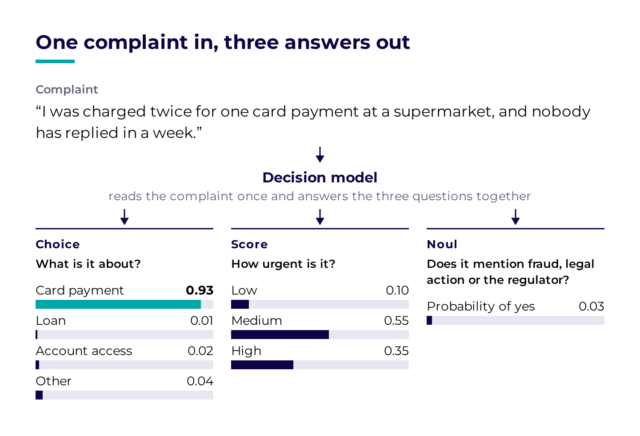
The figure’s questions use Jev’s three question types:
- Choice picks one of several named options, such as the team a complaint goes to.
- Score places the answer on a scale of levels the business defines, such as urgency.
- Noul gives the probability of yes for a single check, such as whether fraud is mentioned.
A company does not retrain Jev. The same model serves every customer, and a business adapts it by writing its own questions, options and rules into each request. Jev was the first commercial model of this kind, and open alternatives appeared within a week of its launch.
How a decision model differs from a language model
TypeSafe calls Jev a System One model, after Daniel Kahneman’s Thinking, Fast and Slow, which separates fast, intuitive System 1 thinking from slower, deliberate System 2 reasoning. The mapping onto machines is TypeSafe’s, not Kahneman’s.
A general-purpose language model, the kind behind ChatGPT, writes its answer a word or part of a word at a time, so even a one-word verdict has to be written out. In exchange it can draft a reply, explain itself and reason through several steps. Jev reads the material once and answers all its questions together, and TypeSafe says most requests finish in about a tenth of a second.
In one study, labelling 1,000 texts cost Jev under 3 cents, against about 60 cents for Gemini 3.5 Flash-Lite and 86 cents for Gemini 3.8 Flash, two fast reasoning models. Its documentation also says Jev may struggle with questions that need several steps of reasoning, and advises passing uncertain answers to a person or to a reasoning model, a language model built to work through a problem in steps before it answers.
Where decision models fit
The best candidates are decisions a business makes again and again, whose possible answers are known in advance, and where each answer already has an action attached. Where the answers are open or a wrong decision is costly, a reasoning model or a person belongs in the loop.
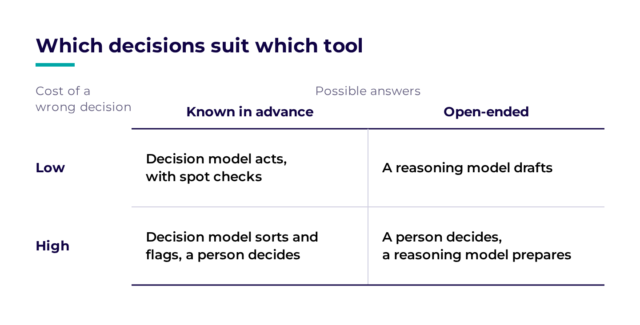
All four uses below are on TypeSafe’s list of intended uses.
- Routing tickets. A bank or telco receives complaints and requests every day. A decision model can classify each one by issue, product and urgency and route it to the right team.
- Sorting records at volume. Researchers at Texas State University used Jev to code 195,857 police crash reports, answering 27 questions about each, for about $30 in total. TypeSafe proposes the same for insurance claim notes and customer identity documents.
- Choosing which AI model handles a job. Simple requests can go to a cheap model and hard ones to an expensive one, with a decision model making that call on every request. None of the studies cited here tests this use.
- Finding the right document. In TypeSafe’s own test on legal case searches, re-ranking a keyword search’s shortlist with Jev raised the share of queries with the correct passage in first place from 5% to 18%, a gain from a low base.
Pairing a decision model with a reasoning model
In a larger process, a decision model can be the first stage, with a reasoning model and people behind it. Researchers at NYU Abu Dhabi tested that arrangement on social-science text-labelling tasks. Keeping Jev’s confident answers and passing the rest to a leading language model held that model’s accuracy at roughly half its cost, because the two kinds of model got different items wrong. The saving comes from the decision model settling the clear cases.
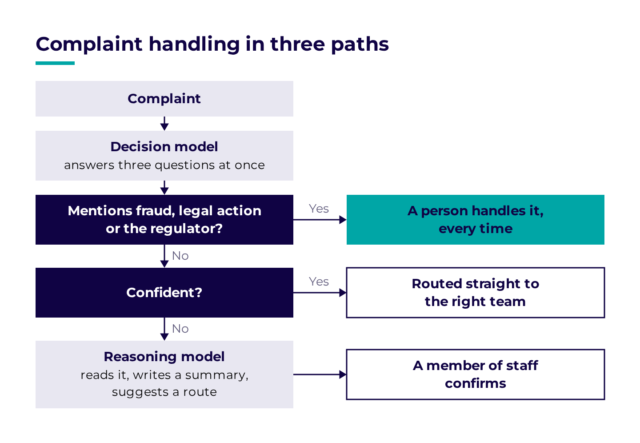
NYU’s tasks were not complaints, so what follows is an illustration of the arrangement at a bank rather than a tested deployment. For every complaint, the decision model answers three questions at once: what the complaint is about, how urgent it is, and whether it mentions fraud, legal action or the regulator. Code then sends each complaint down one of three paths.
- When the answers are confident and the complaint is routine, it goes straight to the right team.
- When an answer is uncertain, a reasoning model reads the complaint in full, writes a short summary and suggests a route for a member of staff to confirm.
- When fraud, legal action or the regulator is mentioned, a person handles the complaint every time, however confident the model is.
Limitations
- It can be confidently wrong. On one task in the same study, judging empathy in peer-support conversations, Jev performed near chance while reporting high confidence on most answers.
- A decision model does not explain its answers, which matters wherever a decision has to be justified to a customer or a regulator.
- A complaint that fits none of the categories is forced into one of them unless the list includes an “other” option, as TypeSafe’s guidance recommends.
Discussion
Decision models are useful for narrow, repeated decisions once they have been tested on your own data, and their speed and price are the obvious attraction. A probability a business can trust would matter more, since it decides which cases the model may settle alone and which it must pass on. The empathy result shows why that trust has to be checked before anyone relies on it.
Start with a decision your staff already make and record, such as the category of last year’s complaints, run the model over those cases and compare its answers with theirs. Where it matches and its confidence tracks its mistakes, let it settle the clear cases. Some decisions, like the flagged complaints above, deserve independent review whichever model makes them, and for those a high probability is no reason to skip the person.