
- Work you can define and check can be handed over to AI. Deciding what a customer is owed cannot.
- Simply editing a recommendation does not make it yours, and nobody owns an output they cannot change.
- AI can make wrong answers look like right ones; ensure proper guardrails are in place.
Choosing the work
Start with one task whose inputs and acceptable outcome you understand well. It might extract fields from documents, prepare a summary you can check against the document, or draft replies from an approved policy.
- Can the AI tool access the information needed, with permission to use it?
- Can someone assess whether the output is correct and useful?
- What happens when it is wrong, and can the error be caught before it affects someone?
Sometimes the process needs redesigning first: better data access, fewer handoffs, clearer authority. A small trial exposes that too.
Counting the benefit
Decide what improvement would justify keeping the tool. Lower costs, a lighter workload and better service are separate benefits, and because a tool can deliver one of them without delivering the others, a proposal should name the one it is claiming.
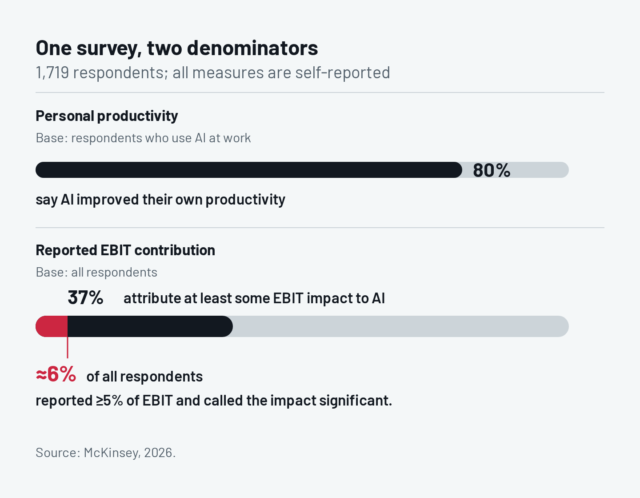
In McKinsey’s 2026 survey of 1,719 people, 80% of those who use AI at work said it had improved their own productivity. 37% of all respondents said AI had contributed something to their organisation’s EBIT, and about 6% put that contribution at 5% of EBIT or more and called it significant.
Less staff effort can be worthwhile without a smaller payroll. But record the time spent checking and correcting outputs, including work passed to colleagues.The Work AI Index, a survey of 6,000 full-time digital workers in America, Britain and Australia, puts it at 6.4 hours a week: giving the tool context, checking answers, fixing mistakes, running prompts again. The estimate is self-reported, but it is a cost proposals can easily leave out.
If claiming savings, identify the expense that will actually fall. If claiming better service, measure whether customers get an accurate resolution sooner, rather than a quicker first response. Make sure to account for the opportunity cost of time and effort as well.
Preserving judgment
Proposal writing with AI deserves a different approach from document processing. Use AI to suggest perspectives, find objections and expose assumptions. The person presenting the recommendation should be able to explain why it addresses the problem and why the alternatives were rejected.
Light editing is a poor test of that understanding, because even a person who has rewritten every sentence in a proposal may still have left the tool’s priorities, and its conclusion, exactly where they found them.
In a three-month trial of 133 patent lawyers, published by the NBER in September 2026, AI improved their work on benchmark drafting tasks, the juniors most of all. On a different task afterwards, without AI, only the senior lawyers were ahead of the control group; the juniors showed no average gain. The researchers, who asked whether AI erodes expertise, concluded that “the largest gains from AI thus accrued to the lawyers who retained the least”.
Ask people to state their initial judgment before seeking AI’s suggestions, and to explain what changed their minds. NIST names the failure this guards against: “automation bias, or excessive deference to automated systems”.
Errors and responsibility
Two measured error rates, each its own test
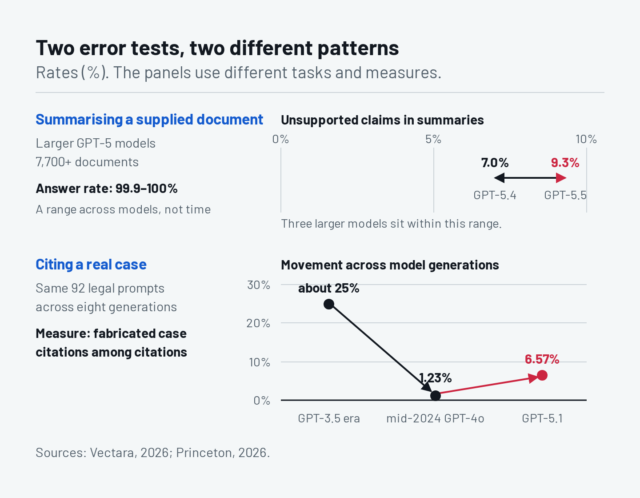
Rates like these are only tolerable where someone catches them. Leaders must provide workable oversight. An employee should answer for accepting an output only where they can competently review it and have the authority to change it, and where a manager demands automatic acceptance instead, the failure belongs to the manager.
Conclusion
Before buying or expanding an AI tool, the proposal must identify the task, the expected benefit, the evidence needed to test it and the person responsible for accepting its output. Where checking cannot be done competently, reduce the tool’s authority or keep the decision with a person.